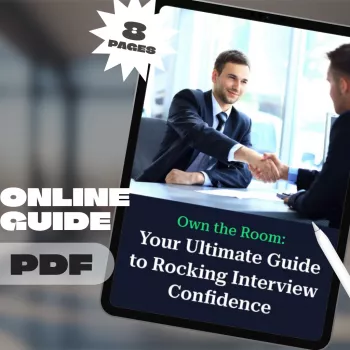
Interview confidence is less about “feeling fearless” and more about having a repeatable system: calm the body, clarify the message, and practice delivery until it’s automatic. When you can regulate your nerves, lead with a clear point of view, and communicate in clean, structured answers, you come across as credible from the first greeting. Below is a practical approach to confident behavior before, during, and after the interview—plus a digital option that keeps preparation organized and reusable.
“Owning the room” isn’t about dominance. It’s about signaling steadiness and competence in ways interviewers recognize quickly—especially in the first minute.
Those behaviors are learnable. The key is to build a system that reduces uncertainty and makes your delivery feel familiar under pressure. For general interview best practices and manager expectations, Harvard Business Review’s resources on job interviews are a helpful benchmark.
The 48-hour window is where confidence is “installed.” Instead of cramming more research, focus on a small set of repeatable assets you can use in any interview.
| Timeframe | Focus | What to do | Outcome |
|---|---|---|---|
| 48–24 hours | Message | Write role thesis + 6–8 stories with results | Clear narrative and proof |
| 24–12 hours | Delivery | Record 2–3 answers; adjust pace and structure | Polished communication |
| 12–2 hours | Logistics | Confirm time zone, route, links, charger, backup plan | Fewer surprises |
| 90–15 minutes | Regulation | Light movement + water; limit caffeine spikes | Calm energy and focus |
If stress symptoms spike (tight chest, shallow breathing, shaky voice), it can help to understand what stress is doing physiologically—then respond with regulation tools. The American Psychological Association’s overview of stress effects on the body is a useful reference.
Confidence shows up when your answers land quickly and cleanly. Frameworks give you control without making you sound robotic.
A quick practice drill: pick one story, deliver it in 45 seconds, then again in 30 seconds. The goal isn’t speed—it’s prioritization. You’ll feel where you tend to ramble, and you can trim the non-essential context.
You don’t need “perfect” body language. You need fewer distracting signals and more stable ones—especially during introductions and your first two answers.
If you want a reusable system you can pull up before any interview, a structured guide can reduce last-minute panic and keep your prep tight. The Own the Room: interview confidence eBook (PDF download) is designed to help you build a story bank, tighten answer structure, and practice confident delivery in a way that’s easy to repeat across roles.
For recording practice and playback (a fast way to improve pacing and clarity), a reliable set of wired earphones can help you catch filler words and rushed endings more accurately. The Hi-Res Dynamic In-Ear Earphones with MMCX Cable & Dual Plug Options are a practical option for focused practice sessions without audio lag.
Focus on controllables: write a one-page role thesis, rehearse 6–8 stories out loud, do a short record-and-replay drill, and use a calming routine (slow breathing plus grounded posture). Systems beat last-minute cramming because they stabilize delivery under stress.
Use a reset protocol: pause, take one slow breath, repeat the question out loud, then start with a clear headline answer. Rely on structure (Headline → Evidence → Relevance) and keep a few “default” examples ready for common themes.
Pair results with context: quantify impact, credit collaboration, and connect achievements to what the employer needs. Use direct language (“I led…”, “The result was…”) and balance it with curiosity (“What does success look like in the first 90 days?”).






Leave a comment
You must be logged in to post a comment.