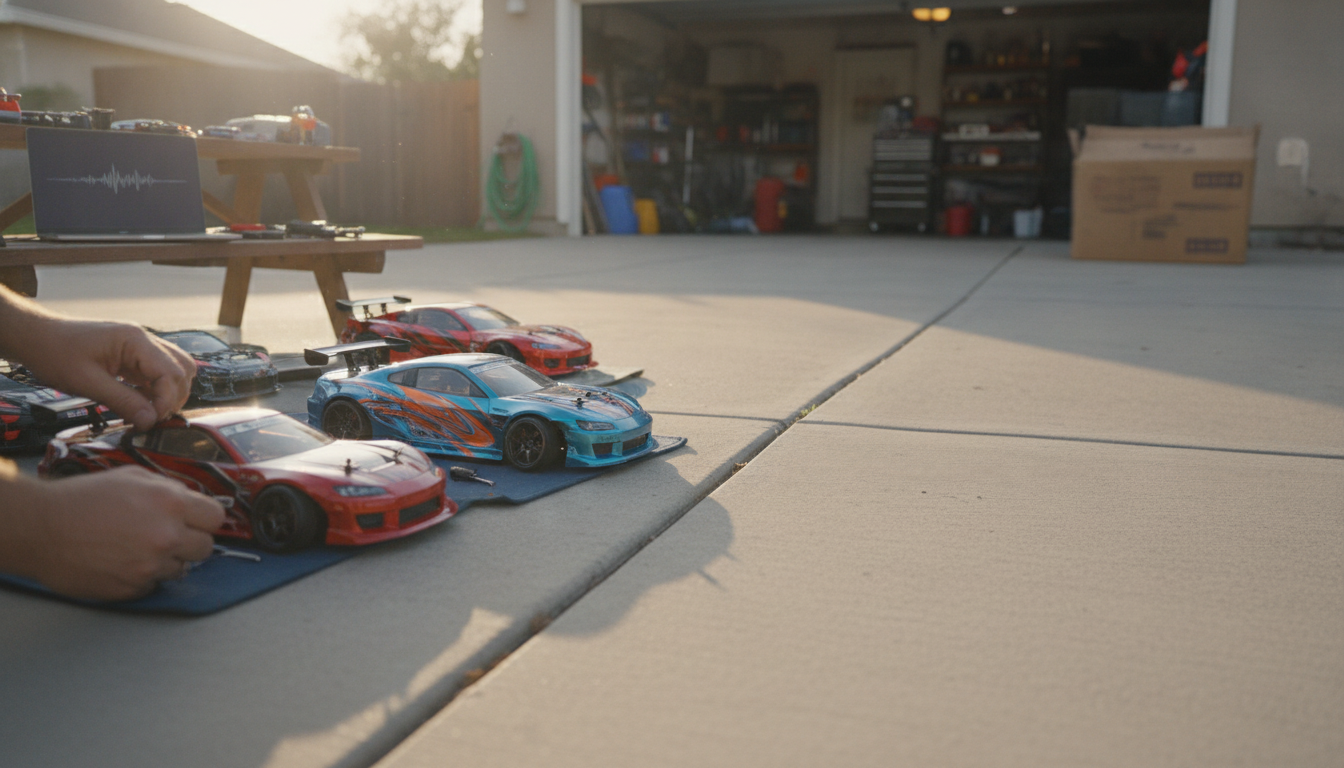
RC drift is a style of radio-controlled car driving where the goal is to intentionally break traction and slide through turns in a controlled, stylish way—similar to full-size drift racing. Instead of chasing maximum grip and lap times, RC drifting focuses on smooth throttle control, steering precision, and maintaining a stable angle while the car slides.
Most RC drift setups use hard plastic or low-grip tires to make it easier to initiate and hold a drift on indoor surfaces like polished concrete, tile, or sealed wood. Drivers “feather” the throttle and counter-steer to balance the car mid-slide, linking corners together without spinning out or straightening up too early.
Regular RC racing is usually about speed, braking points, and traction—keeping the tires planted for the fastest line. RC drifting flips that idea: controlled loss of traction is the point, and style elements like consistent angle and smooth transitions matter as much as (or more than) outright speed.
Control comes from a mix of chassis setup and driver inputs. Many drift cars have drift-focused steering geometry for extra steering angle, tuned suspension for predictable weight transfer, and carefully chosen tires so the slide is smooth rather than snappy.
It’s popular indoors because consistent, smooth surfaces help the car slide predictably, and a small track can still feel technical. That said, RC drift can also be done outdoors on clean asphalt or painted concrete—anywhere the surface offers repeatable low-to-medium grip.
For a practical look at indoor RC drifting—especially compact scales and how to set up a small space—see the full guide here: https://idyllie.com/guide-1-64-rc-drift-racing-car-indoor-guide/.
You’ll need an RC car that can drift (or can be converted), a suitable low-grip surface, and drift tires matched to that surface. A small indoor course with tape or simple barriers helps you practice consistent lines and transitions.





Leave a comment
You must be logged in to post a comment.